


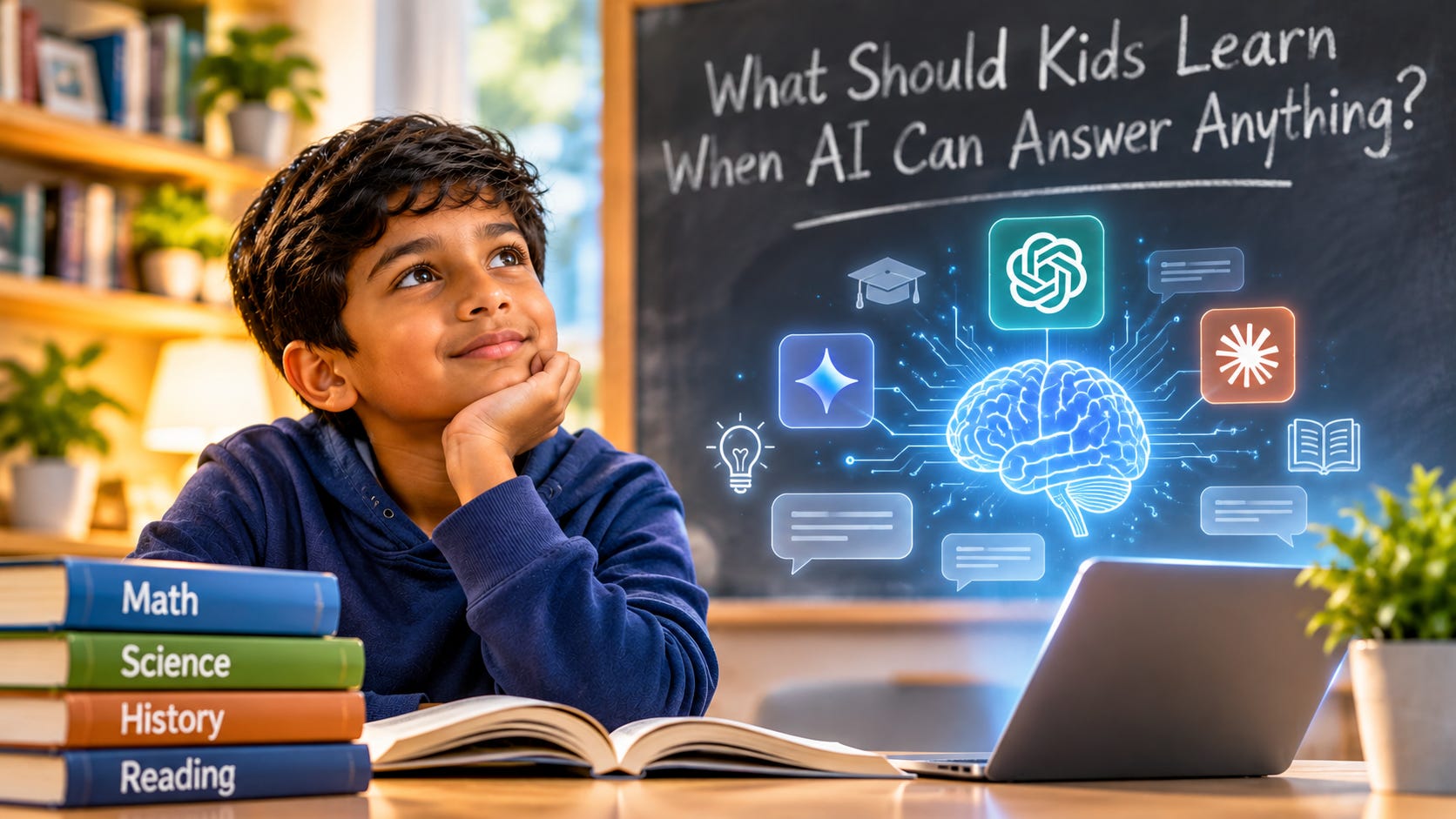
A student today can finish almost any homework in two minutes. Just paste the question into a chatbot, copy the answer, and you’re done.
So if AI can answer almost anything, what do kids still need to learn?
I build AI products for a living, so I started looking into what researchers have discovered about learning and AI. The answer surprised me.
AI doesn’t make learning less important. It changes what kids need to learn and how they should learn it.
Three popular ideas about learning in the age of AI turn out to be wrong. Let’s look at them.
Myth 1: “You can just look it up”
Researchers once gave middle school students a story about a baseball game. Some students were strong readers but knew little about baseball. Others were weaker readers but knew the game well.
Surprisingly, the weaker readers who knew baseball understood the story better.
Why? We understand new information by connecting it to what we already know.
Think of a map. It is useful only if you know where you are starting from.
AI answers work the same way. Without some background knowledge, students may struggle to understand an answer, recognize mistakes, or even know what to ask next.
Myth 2: “Teach critical thinking, not facts”
This sounds reasonable. Facts are everywhere now, so why not focus on teaching kids how to think?
The problem is that thinking always needs something to think about.
Imagine showing a medical scan to two people. One is a doctor. The other is equally intelligent but has never studied medicine.
Both may be good thinkers, but only the doctor is likely to recognize an abnormality. Why? Because the doctor knows what a healthy scan should look like. The other person has no knowledge to compare it against.
Psychologist Daniel Willingham reviewed decades of research on this subject and reached a similar conclusion: how well we think about something depends heavily on how much we know about it.
Facts and critical thinking are not competing skills. Knowledge is the foundation of good thinking.
Myth 3: “AI is fine as long as you use it the right way”
Imagine learning to swim by watching hours of swimming videos. You might feel ready, but when you jump into the pool, you quickly realize that watching someone swim isn’t the same as swimming yourself.
Using AI to get answers can create the same illusion of learning.
In one study, nearly a thousand high school students in Turkey practiced math with an AI assistant. Their practice scores improved by 48%. But when they took a test without AI, they scored 17% lower than students who had never used it.
Adults face a similar problem. In a study by Anthropic, software developers learned a new coding tool. Those who used AI scored 50% on a follow-up quiz, compared with 67% for those who learned without AI.
Here’s the interesting part: students who used AI often believed they had learned more than they actually had.
Getting an answer quickly feels like learning, but it doesn’t necessarily mean you can recall or apply that knowledge yourself.
That’s why simply telling students to “use AI the right way” isn’t enough.
The good news is that AI can also support learning when used differently.
In the same Turkish study, researchers tested an AI tutor that provided hints instead of giving away answers. Most of the negative effects disappeared.
At Harvard, a carefully designed AI tutor helped students learn physics more effectively than a traditional class.
The problem isn’t AI itself. It’s using AI as a shortcut instead of a learning tool.
A simple test: Does this knowledge belong in your head?
So which facts should students actually memorize?
Think about cooking. A good cook doesn’t need to look up how to boil water, but might happily look up a new recipe.
Students need a similar distinction.
Knowledge is worth keeping in your head when it helps with at least one of these three things:
Speed: You use it so often that looking it up every time would slow you down. Examples include word meanings while reading or multiplication tables in math.
Knowing what to ask: You need it to recognize when something is missing. For example, knowing basic history helps you notice when an AI summary leaves out an important war or event.
Checking answers: You need enough knowledge to recognize whether an AI-generated answer makes sense.
If a topic doesn’t serve any of these purposes, looking it up when needed is perfectly reasonable.
This simple test can help us decide where students and teachers should spend their time.
For teachers: Where should class time go?
Teachers cannot control everything students do at home, but they can decide how classroom time is spent.
The principle is simple: go deep on foundational knowledge and spend less time on things that can easily be looked up.
English
Spend more time on: Building vocabulary, developing general knowledge, and expressing ideas in students’ own words.
Spend less time on: Memorizing fill-in-the-blank essay templates.
Math
Spend more time on: Number facts, fractions, basic algebra, and developing an understanding of whether an answer makes sense.
Spend less time on: Repetitive, lengthy calculations by hand.
One long-term study found that students who understand fractions well tend to perform better in algebra years later.
Science
Spend more time on: Understanding a few important concepts deeply, such as energy, forces, cells, evolution, and how scientific evidence works.
Spend less time on: Memorizing long lists of scientific labels and terms.
Social studies
Spend more time on: Understanding the big picture of history, geography, government, and how money and economies work.
Spend less time on: Memorizing long lists of dates and isolated facts.
For students: Five habits to try
Telling kids to “use AI wisely” rarely works. The temptation to get an instant answer is just one click away.
Small, practical habits are more effective. Here are five students can start using today.
Try first, then ask AI. Write down your own attempt before opening a chatbot. It doesn’t have to be correct. Struggling with a problem is part of how learning happens.
Ask AI to teach, not tell. Instead of asking, “What’s the answer?”, try “Teach me how to solve this, one hint at a time.” Remember the Turkish study where an AI tutor gave hints instead of answers? That approach helped students without the negative effects.
Use AI to quiz yourself. Instead of asking, “Explain chapter 4,” try “Quiz me on chapter 4.” Trying to recall an answer helps build memory. Simply reading an explanation often doesn’t.
Review what you learned later. Come back to the same material a few days later, then again a week later. Short review sessions spread over time are more effective than one long study session.
Test yourself without AI. Once a week, solve a few problems without AI or notes. This is the best way to find out what you actually know. As the studies above show, knowledge gaps often become visible only when AI is no longer available.
Start with just one habit and build from there.
What we still don’t know
AI chatbots are still relatively new. We don’t yet have long-term studies showing how years of AI-assisted learning affect children’s knowledge and thinking skills.
Many existing studies follow students for only a few months, and very few focus on younger children.
So these recommendations are based on the best evidence available today, not final answers. We should keep testing and learning as more research becomes available.
Conclusion
AI has made answers almost free. That makes what a student knows more valuable, not less.
A strong foundation helps students understand AI answers, ask better questions, and recognize mistakes.
More importantly, the effort involved in learning and remembering things is what builds lasting knowledge.
Pick one idea from this article and try it this week.
Not sure where to start? Try first, then ask AI.